Directory submissions are still one of the cheapest ways to get a new SaaS its first backlinks and a trickle of referral traffic in 2026. Cheap is not the same as free. A founder working down a list of 300 directories will spend two full days on forms, and a lot of that time is wasted twice: once on submissions that get rejected, and again on listings that get approved but never get crawled. launchdirectories.com tracked one B2B SaaS domain and found only about 27% of its directory listings indexed by Google. A link on a page Google never sees is not a link.
The market also got more concentrated this year. G2 bought Capterra, GetApp and Software Advice from Gartner (announced January 29, closed February 5, 2026, about $110 million according to Gartner's 10-K). The review-site half of the directory world is now mostly one company with a claimed reach of 200 million software buyers a year. That makes a sloppy profile more expensive than it used to be, because the same thin listing now sits in front of a much bigger audience.
We review submissions for SaaSCity by hand, so we see the failure modes every day. Three checks, done before you open a single form, cover almost all of them.
CHECK 1
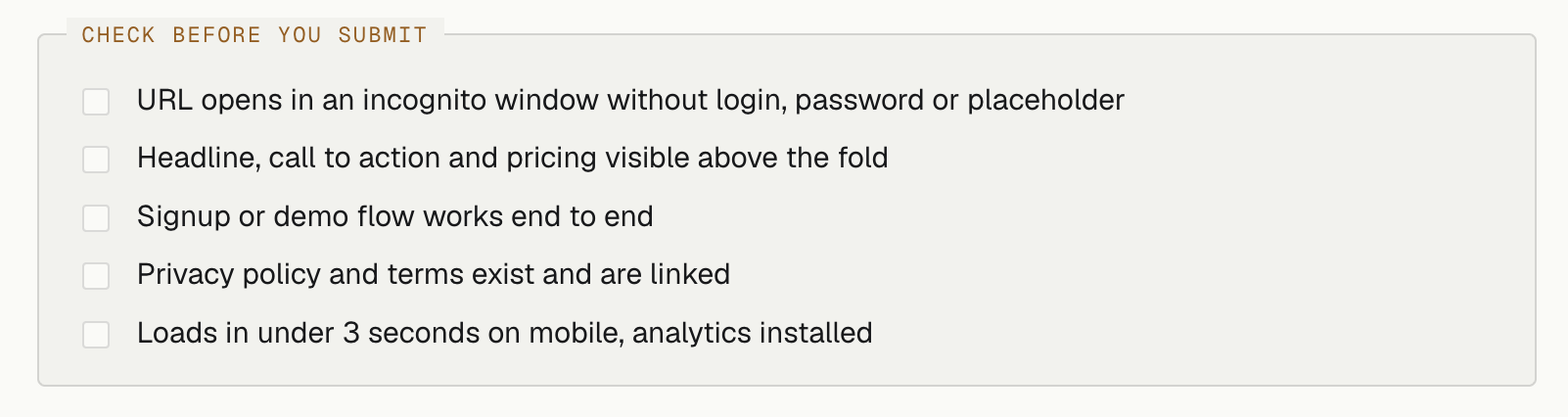
Your product page is public and finished Every reviewer, human or bot, opens your URL before reading a word of your description. If the page is gated, broken or half built, the submission dies right there.
"Public" means no login wall in front of the landing page, no HTTP basic auth left over from staging, and no "coming soon" placeholder where the product should be. A waitlist page is fine on BetaList-style boards, which exist for pre-launch products. It is not fine on G2, Capterra or most curated SaaS directories, which expect something a visitor can use today.
"Finished" means a headline that says what the product does and for whom, a call to action above the fold, pricing a visitor can find without emailing anyone (or a plain "free during beta"), and a page that loads in under three seconds on a phone. Real social proof helps if you have it; borrowed logos hurt more than none. Add a privacy policy and terms, because some directories check for them, and install analytics before you submit so you can later tell which listings sent anyone at all. Schema.org SoftwareApplication markup is a small extra that helps directories and AI crawlers read your page correctly.
The submissions that die at this step in our own queue are the ones where the URL is not a product yet: a preview deploy behind a password, a Notion page standing in for a website, a landing page whose only button opens a form. No directory will pretend those are launches, and neither will Google.
CHECK 2
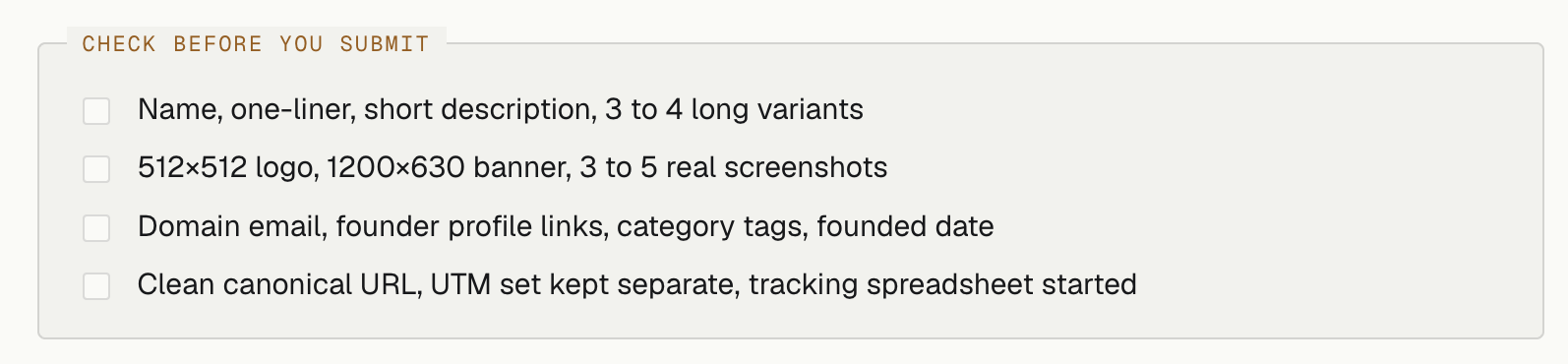
Your submission kit is complete and consistent The second biggest time sink is assets. You get to a form, it asks for a 512×512 logo, you go looking, you crop something, and twenty minutes are gone. Do it once, in a folder, before you start.
Start with the words. Lock the product name's capitalization, because directories copy whatever you type, typos included. Write a one-liner of 50 to 80 characters that states the outcome rather than the feature. Then a short description of around 150 to 200 characters, and three or four longer variants of 300 to 800 words. The variants matter more than people think: paste one paragraph into forty directories and you have forty pages of duplicate text pointing at your site. Lead every version with the problem, then who it is for, then what is different about your approach.
Then the images. A square logo, 512×512 PNG on a transparent background, plus a couple of smaller sizes. A 1200×630 banner for the directories that show a cover. Three to five screenshots of the actual product at 1920×1080, cropped, ideally annotated, without browser chrome. Mockups get rejected by curated directories because reviewers can tell, and get ignored by users because they look like every other mockup. A short demo video helps on Product Hunt and across the G2 family and costs one afternoon.
Then the details reviewers actually check: an email on your own domain, founder name and role, your X, LinkedIn and GitHub profiles, pricing model, a primary category plus two or three secondary tags, and the founding date. We approve plenty of solo founders who submit from a Gmail address, but many directories treat a free email on a company submission as a spam signal, and the fix is a five-minute DNS change.
Last, tracking. Submit the clean canonical URL, never a UTM-tagged one; a tagged URL becomes a permanent backlink to a page Google treats as a variant of your homepage. Keep the UTM versions for your own spreadsheet, which should have at least these columns: directory, DR, date submitted, status, live listing URL, indexed yes or no, notes. That spreadsheet is the only way you will know in two months which directories were worth it.
Build the kit first and a submission drops from twenty minutes to five.
CHECK 3
The directory passes a quality filter- free Domain Rating checker Not every site that calls itself a directory is worth your listing. Most are not. We keep a dataset of 2,404 startup and SaaS directories with live Ahrefs Domain Rating, and the shape of that data is the whole argument.

Filter to dofollow links and DR 50 or above and 2,404 directories become 270. Require a free tier and it is 193. That is the list worth a founder's time. The other two thousand are where bulk submission services send you.
So before you submit anywhere, run the same three checks on the directory itself.
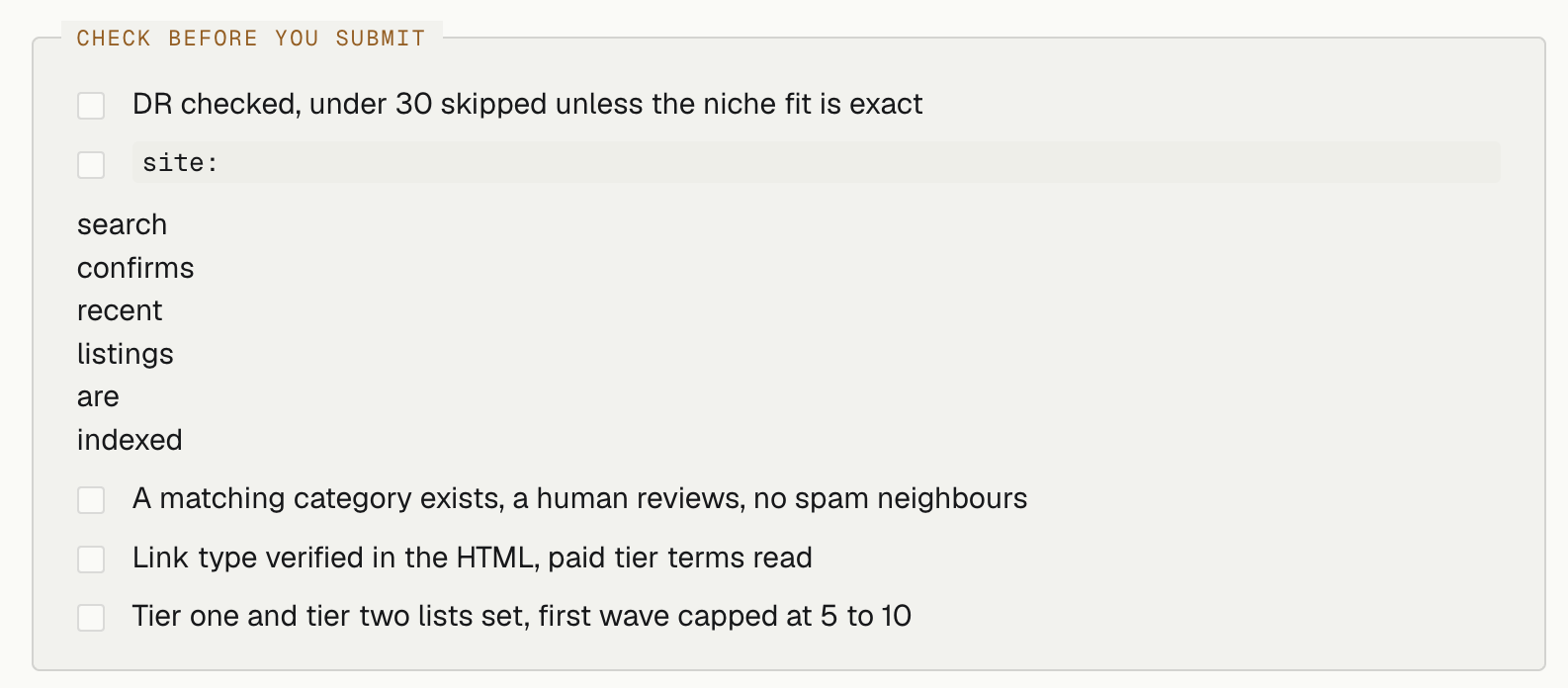
Authority first. Look up the DR (SaaSCity has a free Domain Rating checker that runs on the Ahrefs API, no account needed). Under 30 is rarely worth a form unless the niche fit is exact. Then confirm the site actually gets crawled: search site:directory.com "some recent product" for five recent listings. If none show up, yours will not either. The 27% figure at the top of this article is what happens when founders skip this step.
Relevance second. Does the directory have a category for what you build? Is a human reviewing listings, or does everything go live instantly with a spam listing next to yours? Generic web directories, and anything that lists casinos beside CRM tools, are a pass. AI tool directories have multiplied this year, and they range from properly curated to auto-scraped; check indexation and traffic before you assume the newer ones count.
Link type and terms third. Prefer dofollow, and check it yourself: open an existing listing, inspect the outbound link, look for rel="nofollow" or rel="sponsored". Read what the paid tier actually buys. Some directories charge for a dofollow link that free listings never get; others charge for a featured slot that changes nothing about the link. Note the approval timeline too, hours on auto-publish sites and weeks on curated ones, so a launch does not end up waiting on a queue.
One question covers most of it: would you send a paying customer to this page? If not, the backlink is not worth the association either.
Tiering makes the list manageable. Tier one is the G2 family (submit to G2, Capterra, GetApp and Software Advice separately for now, since they are still separate sites), Product Hunt, AlternativeTo, SaaSHub and StackShare. Tier two is niche directories with DR 40 or higher and confirmed indexation. If you are building tier two, SaaSCity belongs on it: a curated directory at DR 47, free to list, reviewed by a person, with a dofollow link once you place the badge on your site. Cap the first wave at five to ten directories, track for a month, then expand. SaaSCity
THEN Do it once, then submit in batches Three checks: the product is public and finished, the kit is complete, the directory is worth it. Run them once and most rejections and most dead listings never happen.
The workflow we suggest to founders on our own directory: build the kit and the spreadsheet this week. Submit to five to ten tier-one and tier-two directories over the following two weeks, spaced out rather than all in one afternoon. Check approvals and indexation after two to four weeks. Refresh screenshots and copy every quarter, because a 2024 screenshot on a 2026 listing is its own red flag.
directory submission guide for SaaS- The longer version of the method, with directories ranked by live DR, is in our directory submission guide for SaaS. Start with your top three tier-one directories today. The rest can wait for the spreadsheet.