Pressure-test your business idea before you waste time and money building it. Most business ideas are not tested against evidence before resources are committed to them. A concept feels promising, a landing page follows shortly after, and months later the market reveals what a short research process would have shown from the start: the question had already been answered, often more than once.
Marketur is built to close that gap. A Reality Check before you build
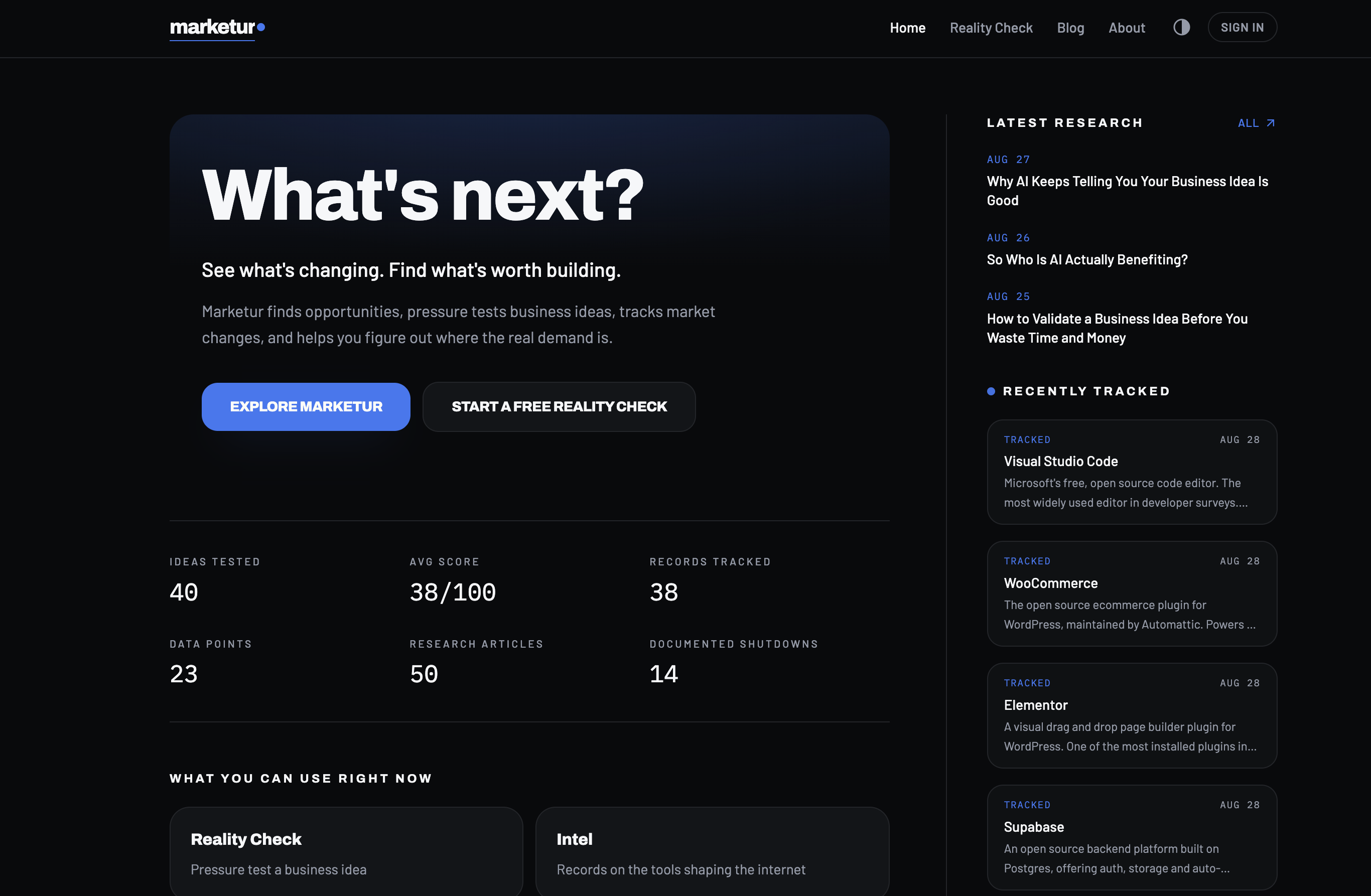
Marketur is an intelligence platform that tracks what is new, what is changing, what is growing, and what is disappearing across the tools, platforms, and online businesses shaping the internet. Rather than relying on instinct, it provides structured data across a few core features: Reality Check — a tool to pressure-test a business idea before significant time or capital is invested, scoring it against tracked market data. Intel database records on existing tools and platforms, covering business model, funding status, and pricing tier. Graveyard documentation of products that have already shut down, including the reasons behind each failure. Deadpool — an ongoing, evidence-based list of products projected to shut down next.
Research articles guides and breakdowns examining why comparable products succeeded or failed. The platform functions less like a single tool and more like an ongoing research operation, with a growing set of tested and scored ideas, tracked company records, and research output examining outcomes across the market. Most validation advice skips the evidence
Common validation guidance — speak with customers, ship an early version, iterate from there — is directionally correct but incomplete. It does not account for what already exists in the market, who has already attempted a similar approach, or why prior entrants failed. That context is typically scattered across outdated blog posts, defunct company pages, and social media threads that are difficult to locate months later.
Marketur's premise is that a meaningful share of wasted effort in early-stage validation is not a research problem but a findability problem: the relevant evidence exists, but it is rarely centralized, structured, or searchable at the point a decision needs to be made. What sets it apart: studying failure, not just success An evidence-first approach, rather than a generic scoring quiz. The Reality Check tool evaluates ideas against tracked data rather than a standardized checklist.
The Graveyard and Deadpool sections represent a distinct approach. Most platforms focus exclusively on paths to success; this one also documents failure, with specific reasons behind past shutdowns and an ongoing list of products projected to fail next.
Intel records are structured for due diligence, not marketing. Entries summarize business model, funding status, and pricing tier concisely, designed for efficient comparison across multiple tools. Research content substantiates the data rather than replacing it. Guides on validation and shutdown analyses provide the underlying reasoning, not just the outcome.
For anyone about to bet time or money on an idea This is relevant to anyone preparing to commit time or capital to a new idea: founders evaluating a concept prior to development, product teams assessing a feature in a saturated market, and investors or operators seeking a quick assessment of whether a given tool or platform is growing or declining. Where a validation process currently consists of a brief, informal search, Marketur is designed to replace that step with a more evidence-based assessment.