If you've ever worked with clients or a team on a live website, you know the drill. Someone sends a screenshot with a red circle drawn on it. Someone else asks "which page is this on?" A third person spends ten minutes trying to reproduce the issue because nobody wrote down the browser or screen size. What should be a two-minute fix turns into a half-day thread. Tweak.page is built to kill that thread entirely.
Pin the feedback right on the page
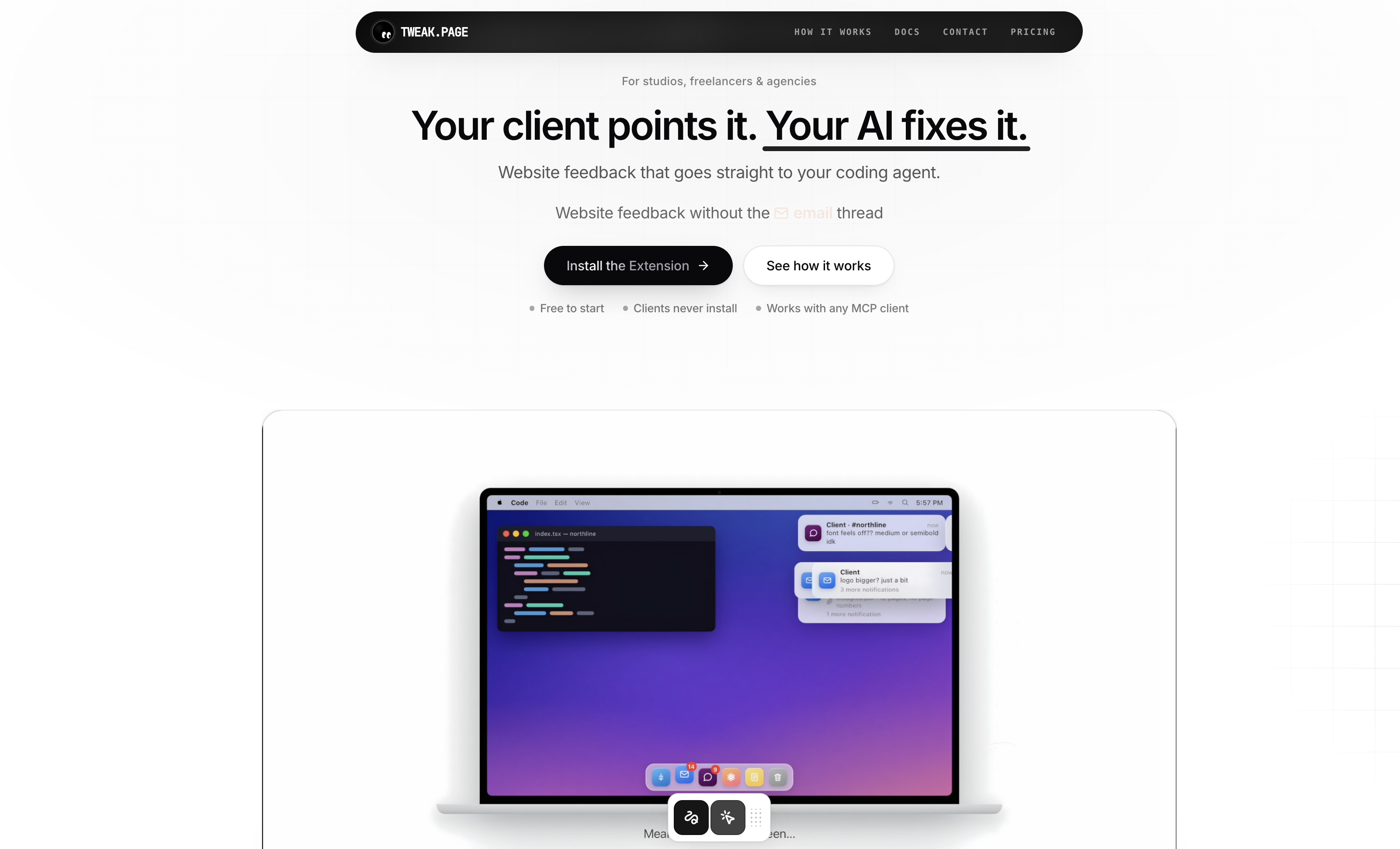
The idea is straightforward: clients (or teammates) pin feedback directly onto your live or staging site, right where the issue actually is. No screenshots, no guessing which page, no "can you send me the link again." Your team sees the pin, replies, assigns it to someone, and marks it resolved — all from a central hub instead of a scattered inbox or email chain.
It also ships with an MCP integration for Cursor and Claude, which is a nice touch if your workflow already leans on AI coding tools — feedback can flow straight into the tools your developers are already using, instead of living in a separate app they have to remember to check.
Why this matters
A broken feedback loop has a real cost: every round of "wait, what page/browser was this?" is time that should be going toward the actual fix instead. Screenshots get sent without context, pages get misidentified, and issues that should take two minutes to resolve stretch into a half-day back-and-forth.
It's also a category a lot of teams underestimate until they're mid-project and realize their "process" is a Slack channel full of unlabeled screenshots. No more screenshots, no more guessing
Feedback lives where the problem is. Pinning comments directly on the page removes almost all ambiguity about what's being reported. No separate accounts or link juggling for reviewers. Clients don't need to learn a new tool to leave feedback — they just interact with the page itself. The hub keeps everything centralized. Replies, assignments, and resolution status in one place instead of split across email and screenshots. MCP support is forward-looking. Plugging feedback directly into Cursor/Claude workflows is a genuinely useful bridge between "client said this" and "developer fixes this," and not many tools in this space are doing that yet. Built for lean teams, not agencies
Most tools in this space — BugHerd, Marker.io, and similar — get feedback off screenshots and onto the page, then route it into a ticketing board for a team to work through. Tweak.page skips the board entirely and sends feedback straight into the AI coding tools developers already use. Built for lean teams, not agency workflows. A lot of established players lean toward multiple client accounts, heavier permission structures, and integrations built around ticketing systems like Jira or Trello — the right shape for an agency juggling a dozen client sites, overkill for a small team shipping fast.
Skips the ticketing-system middleman. Instead of feedback creating a card in a board somewhere, it flows straight into the tools developers already live in. MCP integration for Cursor and Claude. Feedback becomes context an AI coding tool can act on directly — a workflow that basically didn't exist when most of the incumbents were built. Narrower, more current focus. It's a younger product, so it doesn't carry a decade of agency-specific features — but for a team whose bottleneck is "how fast can a client comment turn into a fix," that focus is arguably the point, not a gap.
Who this is actually for This fits any team that ships and iterates on live pages with other people watching — freelancers working with clients, small dev teams taking feedback from stakeholders, or founders getting input from testers before a public launch. If your current process runs through screenshots, DMs, or a shared doc nobody updates, or if your workflow already lives in Cursor or Claude, it's worth a look.