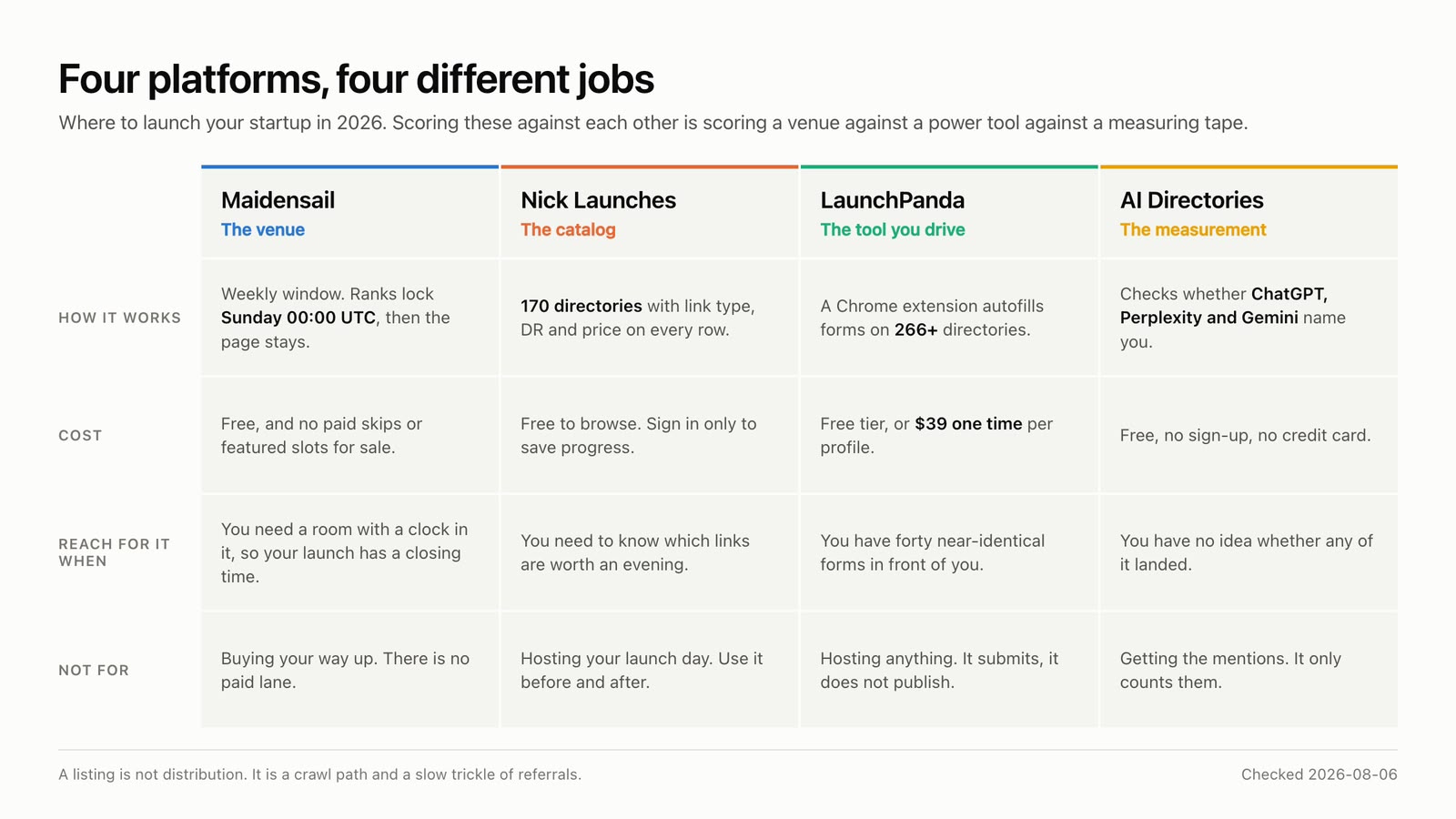
Where to launch your startup is usually asked as if there is one right answer with a ranked list underneath it. There is not. The four platforms below do four different jobs. Scoring them against each other would be scoring a venue against a power tool against a measuring tape.
I run Nick Launches, a product discovery directory for indie founders. I have submitted to a few hundred directories by hand and wasted a fair number of evenings on submissions that were never crawled.
Disclosure: Nick Launches is one of the four, and this post is running on Maidensail, which is another. So I have an interest in founders listing their products. The numbers below are dated and sourced so you can check them yourself.
![Four platforms compared by the job each one does, how it works, cost, when to reach for it and what it is not for]
Maidensail: the venue
A venue gives your launch a room, a clock and an audience. Maidensail runs on a weekly cycle: you debut into a week, votes accumulate, and at Sunday 00:00 UTC the ranks for that week lock. The week of 3 to 9 August 2026 carried 30 debuts.
The clock is the part that matters and the part founders skip. A launch with no closing time is not a launch, it is a page. A defined window gives you a reason to message people this week rather than eventually, and a leaderboard gives them a reason to click today rather than never.
After the week closes, the page stays. Maidensail describes it as your page living in the Registry permanently, with a dofollow backlink on every listing. There is also a verification badge you can embed on your own site, which earns a check mark on your listing.
Pricing is the unusual part: free, forever, with the site stating plainly that there are no paid skips and no featured slots for sale. Most launch platforms keep a paid lane. Not having one removes the question of whether the top of the leaderboard was bought.
There is also MergeDeck, an M&A marketplace run by the same team, for startups with revenue that are ready to raise or exit. Worth knowing about, though it is a different problem from the one you have on launch week.
Nick Launches: the catalog and the instrumentation
This is mine, so read the rest of this section with that in mind.
Nick Launches is a discovery directory, but the piece I would point a founder at first is not the directory. It is the catalog.
![The launch directory catalog, showing 170 of 170 directories with columns for domain rating, traffic and backlink strength, and dofollow and pricing tags on each row]
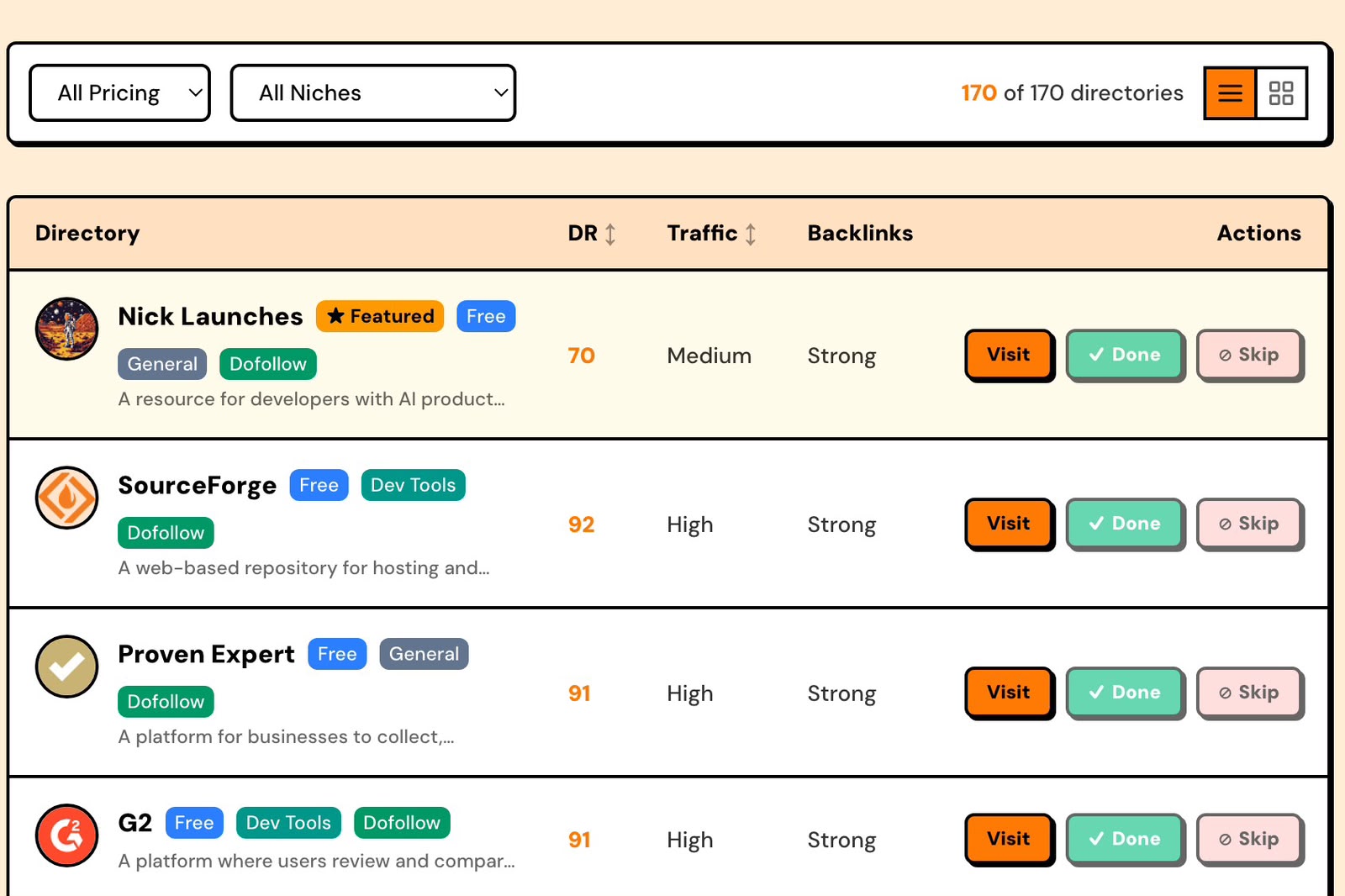
That is a catalog of 170 launch directories, free to browse without an account. Every row carries domain rating, traffic level, backlink strength, pricing and, the detail that saves the most time, whether the link is dofollow. It also flags the directories that want a badge on your site in exchange for the link. Sort by DR or traffic, filter by price and niche. Marking entries Done or Skip needs a sign-in, since that state has to live somewhere, but reading the table does not.
That dofollow tag exists because submission count is the wrong metric. One hundred listings where eighty are nofollow, on pages Google has not fetched in two years, are worth less than twelve dofollow listings on pages crawled weekly. The eighty are not neutral either. They cost you the evenings you could have spent on the twelve.
The directory itself works as you would expect: free submission, a permanent listing, a dofollow link, a category, and a leaderboard that ranks builders by launches and upvotes rather than ranking only products. There were 92 launches in the current week. There is also an API and an MCP server, so you can query it from Claude Code instead of clicking through it.
One disclosure for the next section: that catalog has a browser extension attached which autofills directory forms, so I am in the tool category too. I would rather you got the comparison from someone who declares the overlap.
LaunchPanda: the tool you drive
LaunchPanda does not host your launch. It makes you fast at submitting to everyone else's.
You fill in one startup profile: name, tagline, descriptions at several lengths, logo, categories, links. A Chrome extension then autofills submission forms on the directories you visit, so each becomes a check-and-submit instead of a retype.
Their catalog is 266 or more hand-curated directories, ranked by the traffic and backlinks each actually delivers rather than by DR alone. On top of that sit seven ordered submission sequences for different goals, so you are not choosing blind from a list of 266.
Their own arithmetic: one to two minutes per directory with the extension, roughly four hours to cover 140 or more, against 40 hours by hand. That matches my experience, where manual submission runs five to fifteen minutes each once you count captchas, confirmation emails and the forms that lose your input.
The free tier gets you one profile, three of the seven strategies and DR tracking. Pro Max is a one-time $39 per profile and opens the full list, the extension and unlimited profiles.
One detail I respect: their refund policy states plainly that a refund reverts your launches and removes the dofollow backlinks. Most submission services do not tell you what happens to the links when you ask for your money back.
AI Directories: the free measurement
AI Directories covers 100 or more directories specific to AI products, and sells a done-for-you submission service that is outside what I am covering here.
It is on this list for the free layer: more than fifteen tools with no sign-up and no credit card. Most are ordinary. One is not.
The AI Mentions Tracker checks whether ChatGPT, Perplexity and Gemini name your product, with a separate tracker per engine. Almost nothing else in launch tooling gives that away free.
It matters because launch traffic and AI citations come apart. A product can have a good launch week and still be invisible when a buyer asks an assistant for the best tool in its category. When I audited my own site, a third-party trust-check page I do not own and did not write was cited more often than my own homepage was. The full method is in how to audit your site's AI visibility. For the five-minute version, their tracker is a reasonable start.
A realistic first week
Do these in order. The order is the point.
Day one, launch on a venue. Pick somewhere with a weekly cycle so your launch has a defined window and a leaderboard to climb, then tell the people who already follow you. One venue done properly beats five done at once.
Days two to four, work the list. Open a directory catalog, sort by whether the link is dofollow, and submit. This is where a tool pays for itself, because the work is identical forty times over.
Day five, take a baseline. Run the mention check across ChatGPT, Perplexity and Gemini and write the answer down, including the zero if it is zero. In week one it nearly always is. You cannot see movement without a starting number.
Then wait. Directory links get crawled on the directory's schedule, not yours. Re-check in a month.
What none of these do
A listing is not distribution. None of these puts your product in front of a buyer who was already looking for it. They put you where crawlers and browsers pass by. Founders who expect customers from a directory submission are usually disappointed. The ones who expect crawl paths and a slow trickle of referrals are not.
For a young domain the useful thing a directory gives you is often not the link equity anyway. It is the crawl path. Google has to discover your URL before it can judge it, and on a new site it frequently has not. You cannot fix that by asking Google harder: I pushed 200 URLs through its Indexing API and got zero discovery, which matches Google's own documentation that the API acts on JobPosting and BroadcastEvent pages and ignores everything else. IndexNow reaches Bing and Yandex, not Google. A listing on a page Google already visits is one of the few levers left.
Which means a directory Google does not crawl is not a weak backlink. It is nothing at all.
Many directory links are also nofollow or badge-gated, and the listing page rarely tells you which. Check the rel attribute yourself before you count a link as won. A badge-gated link means trading a link on your site for a link on theirs, which is a fair deal as long as you know you are making it.
Finally, DR is not traffic and it is not evidence. A directory that links out to fifty thousand products with no editorial gate will often carry a respectable number while passing very little along. Read it alongside how selective the place is, and treat two identical DR figures as two different things until you know what is under them. That applies to mine as much as anyone else's.
FAQ
Where should I launch my startup first?
Somewhere with a defined launch window and an audience of builders, so you get a ranked week rather than a page nobody visits. Then treat the next thirty directories as background work rather than as launches. Launching everywhere on the same day splits whatever attention you have.
Do directory backlinks still work in 2026?
The link half works when the link is dofollow, and a good share are not. The half that consistently pays for a new domain is discovery, for the reason given above: a listing on a page that already gets crawled is one of the cheaper ways to put your URL in front of a crawler.
Should I submit to directories myself or use a tool?
Under about twenty, do it by hand and learn what the forms ask for. Past that, the work is repetitive enough that a tool wins. Either way, check the rel attribute on your live listings afterwards, because that is the part no tool verifies for you.
How do I know whether my launch worked?
Pick your measure before launch day. Referral traffic in analytics, listings that are live and dofollow, and whether an AI engine names you when asked for tools in your category. Upvote counts feel like the measure and are the least useful of the four.
Pick the job, then pick the platform
If you need a room with people in it, you need a venue. If you have forty forms in front of you, you need a tool. If you have no idea whether any of it landed, you need a measurement, and that one is free.
Most founders buy the second thing before doing the first, and never do the third at all.
So take the baseline before you submit anything. It takes ten minutes, and it is the only thing that will make next month's numbers mean anything.